| TYPE PROGRAM | VERSI | FILE SIZE |
| MODELING SOFTWARE | 8 | 580 MB |
CONTACT TO ORDER 089637202592
ANSYS Optislang
Overview of ANSYS optiSLang CAE Modeling software:
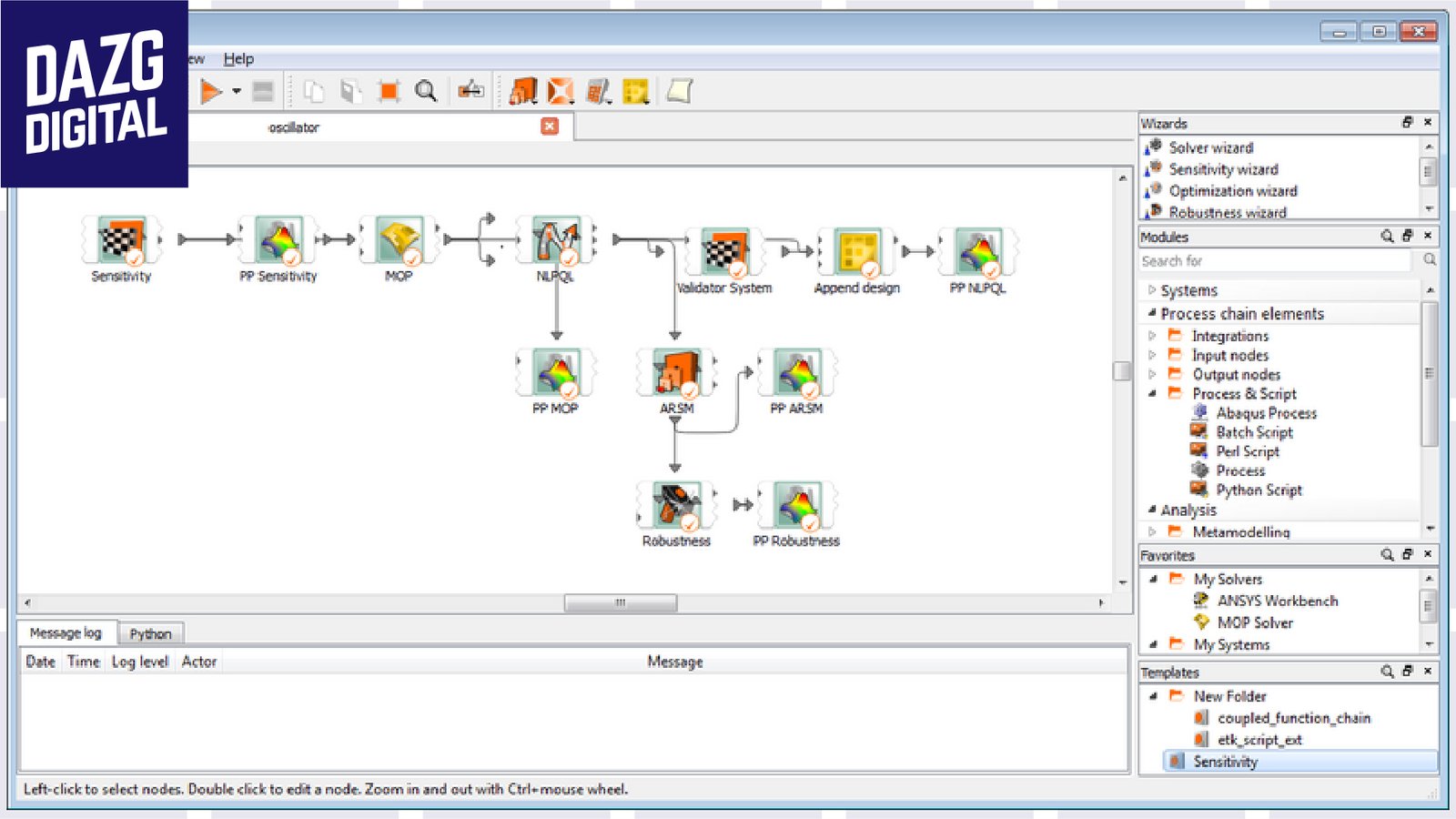
ANSYS optiSLang optimizes your product designs by combining the powerful parametric modeling capabilities of ANSYS Workbench with the powerful design optimization (RDO) methods of optiSLang. The optiSLang Toolbox includes modules for sensitivity analysis, optimization, and robustness evaluation that you can easily drag and drop into a Workbench project to create an interactive pipeline. This workflow enables your engineering teams to improve product performance, identify optimization potential, quantify risk, and ensure resource efficiency.
ANSYS optiSLang features
Process automation
- ANSYS optiSLang has an intuitive graphical user interface that lets you connect computer-aided design tools together in a way that captures both automation and workflow processes, such as performance analysis. sensitivity or robust design optimization.
- ANSYS optiSLang supports communication with most software tools used in virtual product development. Some tools are fully integrated, others can be connected via a text-based interface or custom integration. You can extract the resulting curves using the Extraction Toolkit (ETK) from tools such as ANSYS, Abaqus, Adams, and others.
- Once a simulation process and/or workflow is established, best practice knowledge is captured and can be shared. Geometry can be replaced and other workflows added or adjusted.
Design and data exploration
- Understand your designs or your product data using fully interactive visualization and post-processing tools powered by powerful DOE and statistical analysis algorithms. Knowing how performance is related to design inputs and operating parameters is key to simulation-based product development and a solid foundation for innovation and competitive advantage.
- ANSYS optiSLang provides an automated process flow that reduces variables and creates the best possible response surface for each response with a few solver calls.
Modeling reduced orders
- ANSYS optiSLang builds metadata based on simulation or experimental results. Essentially, a metamodel is a surrogate that learns to respond to inputs the same way a simulation or real system responds, but with fast responses. Running a simulation to predict a given design configuration can take hours or days, but running a reduced order model gives the answer in a fraction of a second. These metadata can be used for powerful design optimization or analysis, or exported for use as ROM in system simulation.
- ANSYS optiSLang algorithms perform three important tasks. First, they identify the relevant parameter subspace, capable of reducing the size of the problem and the number of design points needed to understand it. They then developed a meta-model of optimal prognosis (MOP). Finally, optiSlang tests the metamodel’s prediction quality (CoP) using cross-validation and other methods. Predictive accuracy is critical to the value of drop order models.
Automated design optimization
- Starting from the previous simulation steps, optiSLang is aware of the most relevant parameters and can perform pre-optimization on the metamodel to identify global optimizations. They can also provide user guidance (decision trees) to recommend settings for a specific problem.
- Available algorithms include Evolutionary and Gradient-based algorithms, as well as Pareto Optimization, Adaptive Response Surface, and Global Response Technology. All algorithms come with powerful default settings.
- Models can be calibrated to match experimental data with simulation results. The software can match scalar values or signals and can also determine the most suitable parameters for calibration.
Robust and reliable design
- Evaluate the reliability of a design and perform robust design optimization (RDO) with easy-to-use wizards powered by industry-leading algorithms.
- Robust evaluation is a powerful procedure for checking design quality. It starts with optimized Hypercube Latin Sampling and provides proof of reliability with best-in-class algorithms while testing limits and exceedance probabilities.
- Similar to other optiSLang capabilities, it also identifies the most important scattering variables and provides a decision tree to help you choose the most appropriate robustness algorithms for your specific situation.
Easy access from ANSYS Workbench
- From ANSYS Workbench, you can easily access optiSLang with drag and drop functionality – you just need to set up the space and variation target. Then, powered by powerful algorithms, ANSYS optiSLang automatically determines the metadata of the optimal prognosis. User-friendly project setup wizard identifies appropriate methods for optimization.
- This technology includes options for parallel computing with ANSYS Remote Solve Manager and supports the use of ANSYS HPC Parametric Pack licenses for affordable, concurrent solutions of multiple design points.
- Outstanding features of ANSYS optiSLang:
- modeling
- product optimization
- design optimization